Recurring vs Day-to-Day Expenses
Have you ever decided that it was time to be smarter about your spending? One of the first steps was probably to take a detailed look at your spending. This typically involves making a list of all your categories of spending and calculating how much you spend in each category.
Bills, mortgage, entertainment, food, clothes, video streaming subscriptions, and travel are popular expense categories. But how do you organize everything to make it easy to understand how much you can spend at any time?
A much easier way to think about spending is with just two categories: recurring expenses and day-to-day expenses. This simpler approach to spending can help you create a healthier budget.
Weekly uses these two categories of spending to help you manage your money. Instead of focusing on what the money was used for, we focus on whether the type of spending it is.
Recurring expenses can also be thought of as fixed expenses and day-to-day expenses as variable expenses.
To help you understand the differences between these two categories of spending and how they affect your budget, here is a guide to recurring expenses and day-to-day expenses.
Four Major Differences Between Recurring Expenses & Day-to-Day Expenses
There are three major differences between day-to-day expenses and recurring expenses. These differences are predictability, amounts, and autopay. Understanding these differences is the first step toward an achievable, healthy budget.
1. You have decided in advance how much you will be paying
With recurring expenses, you have decided before hand how much you will pay. So with your rent, mortgage or insurance costs for example, you know ahead of time how much you will be paying and even when you will be paying it. These are recurring expenses. Another way of thinking about this is that depending on the individual choices you make during the week, the amount on your recurring expenses does not change. But if you chose to say buy store brand groceries or choose chicken instead of steak, your grocery bill will change based on those day-to-day decision, so that makes groceries a day-to-day expense.
2. Predictability
Day-to-day expenses can change based on how your week’s turn out. You don’t always know when you’ll need to spend money on your variable expenses. Take clothes shopping, for example. If you have an event to attend this weekend, you might decide you want to buy a new outfit. But you don’t buy a new outfit on a predictable schedule.
Recurring expenses, in contrast, are predictable and occur on a regular schedule. This schedule is usually monthly. There are some expenses, such as your gym membership, that you are fixed to paying every month. If an expense occurs on a regular interval for a predictable or set amount then it is a recurring expense.
3. Amounts
Some of your expenses cost the same amount of money each time you pay them. Others are more variable. Day-to-day expenses have inconsistent costs. What you spend on something one time may not be the same the next time. Travel is a good example. How much you spend depends on how far you’re traveling, how you’ll get there, and where you’re staying. A few nights in a friend’s cabin will cost much less than a vacation to a tropical resort.
The costs of your fixed expenses are much more consistent. Even if they aren’t exact, you can usually create very close estimations for budgeting. Your electric bill might vary a little bit depending on how many appliances you use each month, but the amount is relatively consistent.
4. Auto-Pay
Automation is a great feature of modern society. One day, we might even all have cars that drive themselves. But for now, we can appreciate auto-pay, a feature where scheduled payments are automatically deducted from your account.
variable expenses don’t have this feature. They are point-of-sale transactions that take place at registers in stores or through online ordering systems.
Fixed expenses, however, frequently allow for auto-pay and automatically deduct the payment amount from your enrolled checking account or credit card.
Typical Day-to-Day Expenses & Recurring Expenses
It’s even easier to make sense of variable expenses and fixed expenses when you have an idea of the types of expenses that fall into each category. Once you understand these expenses, you’re on your way to understanding and improving your budget.
Examples of Day-to-Day Expenses
Remember, variable expenses take place at unpredictable times, have variable costs, and don’t allow for the feature of auto-pay.
Examples of variable expenses include:
- Clothing
- Groceries
- Gas
- Eating Out
- Entertainment
- Travel
- Personal Care
- Medical Bills
- Home Repairs
- Car Repairs
Examples of Recurring Expenses
Recurring expenses occur at predictably scheduled times (usually monthly), have fixed costs, and usually allow for automatic payments.
Examples of recurring expenses include:
- Mortgage
- Bills
- Car payments
- Tuition fees
- Childcare fees
- Other loan payments including student loans
- Subscriptions and memberships
Budgeting Basics
Now that you understand the differences between day-to-day expenses and recurring expenses, let’s look at how this can help you with your budgeting. We promise, with these two budget categories, saving money is easy and achievable.
Regular Income and Recurring Expenses
The first step to creating a spending budget is to figure out how much money you make every month. Calculate your guaranteed income by adding up all reliable sources of income. Write this total down.
Next, subtract all of your fixed expenses. Remember, these are your predictable and consistent payments like your mortgage, bills, utilities, and subscriptions. If you want to save a set amount of money each month, you should also consider this a fixed expense.
When you have subtracted your monthly fixed expenses from your monthly guaranteed income, the amount remaining is considered your safe-to-spend amount. This is the amount of money you can safely spend without losing money.
Safe-to-Spend Weekly Amount
Weekly takes your safe-to-spend amount and calculates it as a weekly safe-to-spend. This way, you know exactly how much money you can spend each week and stay within your budget.
You are free to use your weekly safe-to-spend however you’d like to. This money will go toward your variable expenses (what we call day-to-day expenses) but you don’t have to budget by category. If you buy a new video game you might have less money leftover to spend eating out at restaurants, but the choice is completely yours.
Weekly Makes Budgeting Easy
Making smart spending choices is achievable for anyone. With an understanding of variable expenses and fixed expenses, you are on your way to simple budgeting. Weekly makes it even easier!
What is a committed expense vs. a day-to-day expense?
There are two types of expenses within Weekly – committed and day-to-day expenses.
An expense is considered “committed” if it happens at a regular interval for a known amount. Subscriptions, bills, and loan payments are examples of committed expenses. Savings goals are also considered committed expenses. Since these expenses are for a defined amount they’re easy to budget for.
Day-to-day expenses are expenses for things you purchase that don’t have a set amount or are affected by the choices you make through your week. Day-to-day expenses often take place at unpredictable times, have variable costs and are based on in the moment needs and decisions. So in this group are things like gas, groceries, clothing and entertainment.
Weekly takes your regular income and subtracts all of your committed expenses to discover your Weekly Spending Limit. Each week the amount of our Weekly Spending Limit is added to your Safe-to-Spend for the week. Your Safe-to-Spend is used to cover all your day-to-day expenses.
Many budgeting apps ask you to estimate how much money you’ll spend on day-to-day expenses. We believe this approach adds unnecessary complexity to your budget. Instead Weekly has a single bucket for all of your day-to-day expenses – your Safe-to-Spend – but broken down into a weekly amount so you don’t spend too much at any one time. At the beginning of each week, your Safe-to-Spend is increased by your Weekly Spending Limit so you can take budgeting one week at a time.
For more detail on this please read the Knowledge Base article: “The Two Types of Expenses – Committed vs Day-toDay“.
What if a recurring expense changes?
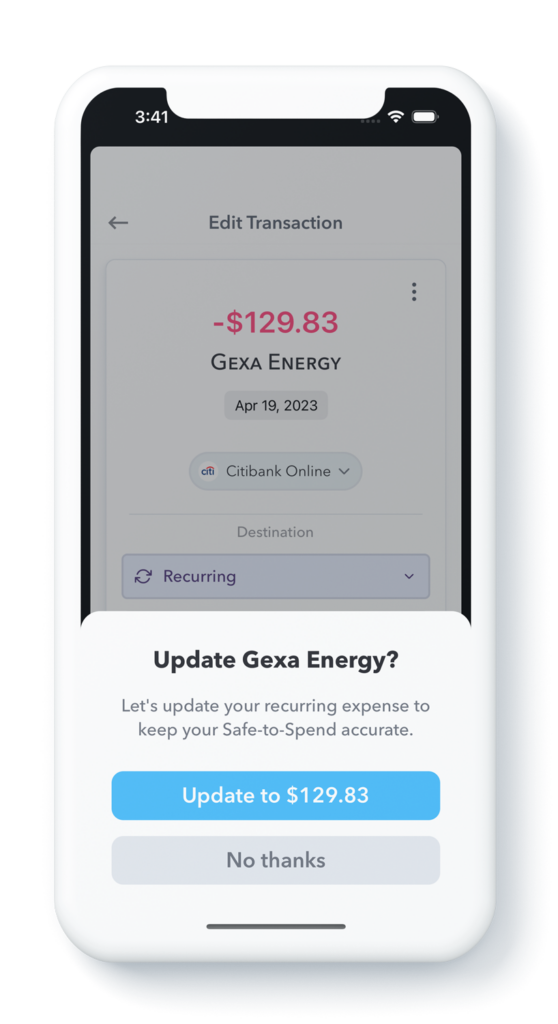
Most recurring transactions are always for the same amount, but some things like utility bills may fluctuate.
When your recurring transaction amount changes Weekly will prompt you to update the amount of the recurring item. If you update the amount then Weekly will immediately recalculate your weekly spending limit based on the new amount. Your Safe-to-Spend for the current week will also get updated.
For example, if your monthly power bill increased by $30 then Weekly would calculate the weekly average by dividing $30 by 4.34524 (the number of weeks in a month) to get $6.90. Weekly would then decrease your weekly spending limit by $6.90 so that you have money set aside for this bill.
There are other ways to handle recurring expenses that fluctuate. One options is to set your expense amount to be the highest amount that you would ever pay and keep it there. Then most months your bill will be lower than what you’ve budgeted for so you’ll have some extra cash in your checking account.
Another option is to sign up for a flat-rate plan which many utility companies provide. This gives you a consistent rate throughout the year.
Note: since Weekly uses averages it’s helpful to have some extra cash in your checking account to make sure you can cover all your bills as things fluctuate.